In today's economic environment, consumers often face the challenge of getting the best value for their money. One sneaky practice that's more prevalent than ever is shrinkflation, where products shrink in size while prices remain the same or even increase. This makes understanding how to effectively read the unit price matrix on grocery shelves an essential skill for budget-conscious shoppers. This guide aims to equip you with the knowledge to bypass misleading promotional pricing and zero in on cost-per-weight metrics, helping you recognize and combat hidden price inflation in your pantry essentials.
First, let's delve into what unit pricing is and why it's crucial. Unit pricing provides a way to compare the cost of products based on a standard unit of measure like per ounce, pound, or liter. This standardization allows shoppers to compare items of different sizes and brands to determine which offers the most value for money. When faced with shrinkflation, where packaging may change or quantities may lessen, unit pricing is your best tool for detecting and understanding the implications on your budget.
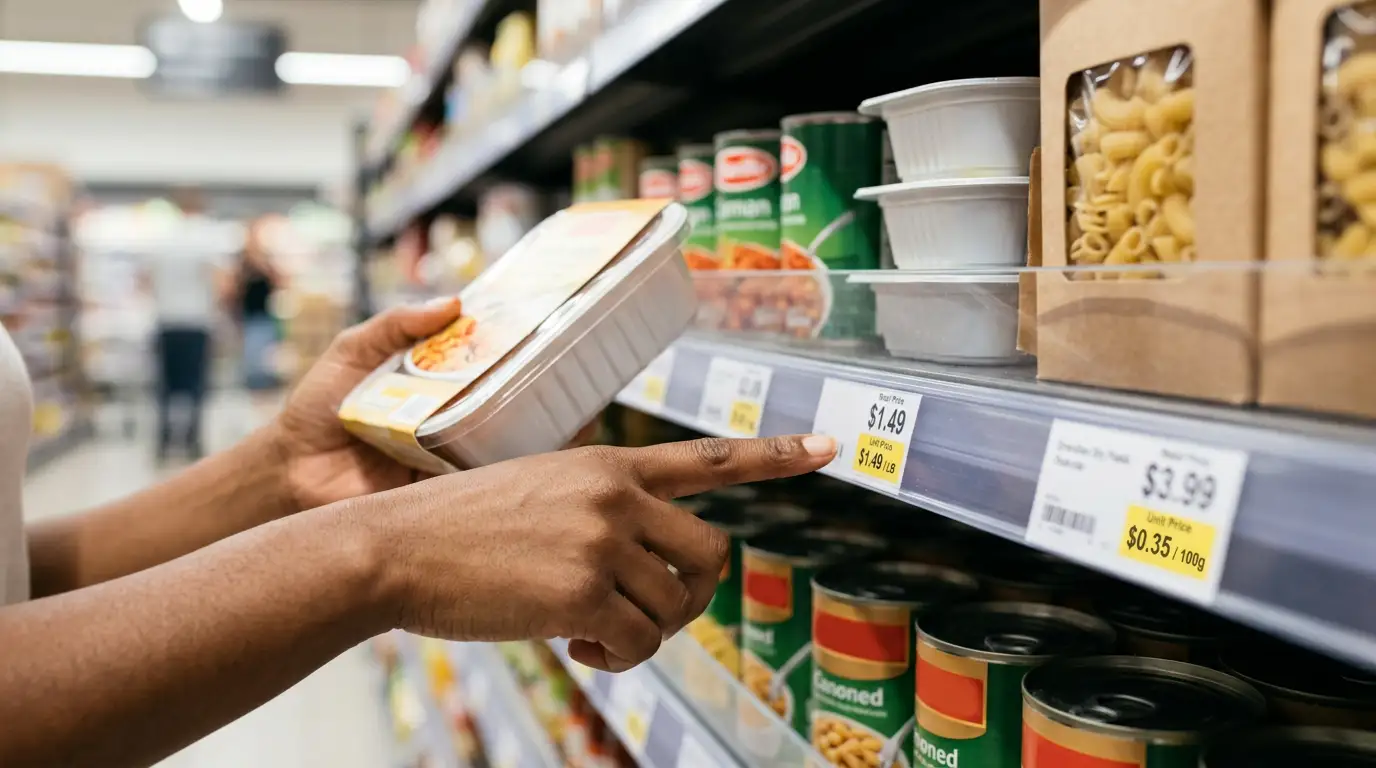
When you embark on a grocery shopping trip, the first step is to locate the unit price label. Typically, this label is affixed to the shelf edge, directly beneath the product. It will list both the total price and the unit price for quick comparison. While total price shows how much you'll pay at checkout, it's the unit price that enables you to discern the real value per weight or volume of the contents. Understanding that a seemingly cheaper item may not offer the actual best value is the first step towards making informed purchasing decisions.
Easy tricks can help you efficiently navigate and interpret unit price labels. First, familiarize yourself with common units used in pricing, such as ounces, pounds, liters, and count (if applicable for items like single-serve snacks or packets). Practice calculating costs based on these standardized units. For example, if one product has a unit price of $0.20 per ounce and another is priced at $0.25 per ounce, then the former offers better value, despite any disparities in total price.
Pay particular attention to promo labels and advertisements that highlight discounts and bundles. While these often appear enticing, they can be misleading without a unit price adjustment. For instance, you may encounter a "buy one, get one free" offer or a reduced price on a multi-pack; yet, the unit price might still be higher than if you bought a larger single package. Your task is to cut through these promotional smokescreens and let unit prices guide your purchasing decisions.
One common pitfall in evaluating grocery items is failing to check the packaging for changes. Companies are known to subtly reduce the content of a package—decreasing it from, say, 16 ounces to 14 ounces—while maintaining the same price. The outward appearance of the container may remain unchanged. Hence, always check the net weight or volume of what you are purchasing, alongside the unit price. If the unit price has risen when compared over time, you may be encountering shrinkflation.
A smart strategy is to maintain a price book. Track the unit prices of frequently-purchased items during your grocery trips. This historical data empowers you with a baseline for comparison, allowing you to detect increases that might otherwise go unnoticed due to stealthy packaging revisions. Over time, you'll build a reference guide that helps make quick, informed decisions based on your accumulated data.
For those not keen on manual price books, dozens of mobile apps are designed to facilitate unit price comparisons. Simply scan barcodes or input product information to instantly compare unit pricing, giving you the confidence needed to resist impulse buys prompted by deceptive pricing strategies. These digital tools also enable you to cross-check competitors without having to travel between stores. Armed with this information, your purchases will be economically wiser and entirely data-driven.
It's also critical you extend these unit pricing strategies to online shopping where image and text-based advertising often lack immediate unit price visibility. Make it a habit to probe product pages for hidden unit pricing details. Online platforms occasionally hide this information amidst other specifications, thereby requiring an extra step of vigilance. Yet the savings realized by doing so can be significant over time.
While it may initially appear time-consuming, mastering the art of unit pricing is an investment in financial literacy. It's about empowering every shopper with tools and strategies to confidently navigate the often bewildering landscape of grocery pricing. By dedicating the energy to understanding and applying the concept of unit pricing, you place yourself in a position of control over how much you spend on day-to-day necessities, insulating yourself and your wallet from the effects of shrinkflation.
At the heart of defeating shrinkflation lies an empowered consumer, one who doesn't settle for surface-level price tags but looks beyond to dissect the real cost per weight or volume. As the grocery market evolves and manufacturers conjure new ways to disguise inflationary pricing, your informed approach and steadfast reliance on unit pricing metrics will serve as your compass, guiding you to make thrifty yet effective choices. Embrace unit pricing as a lifelong skill and enjoy the financial benefits of truly understanding the cost of every purchase decision.